


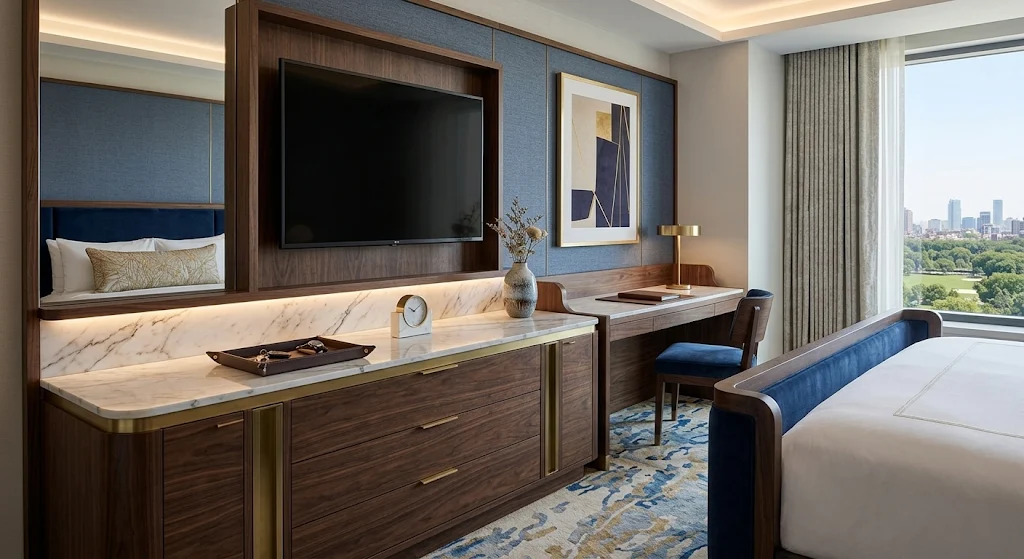
Custom hotel room furniture is bought for two reasons: the brand standard requires a specific look, or the room's dimensions make standard pieces fit badly. Either way, the result depends less on the factory's skill than on the quality of the brief it receives. A vague brief produces furniture that is technically correct and stylistically wrong; a precise brief produces a piece that looks like the render and survives three years of guests. After more than 25 years building custom furniture for five-star hotels, we have learned that the most expensive mistakes are almost always made before production begins.
This guide sets out how to brief a manufacturer so the custom hotel room furniture you receive matches the design intent, meets the brand standard, and can be maintained. It is written for designers, owners, and FF&E teams who need a practical structure rather than a lecture on craftsmanship.
Decide what actually has to be custom
Not every piece in a guestroom needs to be bespoke. Custom makes sense where the brand demands a signature element, where the room's proportions are unusual, or where a standard piece would compromise storage or circulation. It makes less sense for items that are hidden, heavily standardised, or easily replaced.
A useful exercise is to mark each piece as signature, fitted, or commodity. Signature pieces carry the design idea and justify custom tooling. Fitted pieces need to match the room's dimensions precisely but can use standard construction. Commodity pieces — a luggage rack, a simple side table — are usually better bought from a proven standard range. Being deliberate about this split keeps the custom budget where it creates visible value.
The brief: six things a factory needs
A manufacturer cannot engineer what it cannot see. The most effective briefs we receive contain six elements, and the projects that include all six move fastest.
- Dimensioned drawings: plan, elevation, and section, with the critical dimensions marked. A perspective render alone is not a brief.
- Reference images: photographs of the intended look, including details such as edge profiles, joint lines, and hardware.
- Material direction: timber species or veneer, finish sheen, fabric family, stone or glass, and the acceptable alternatives if the first choice is unavailable.
- Brand standard extract: the clauses that govern the piece, including any operator requirements on dimensions, hardware, or safety.
- Compliance requirements: the fire, emissions, and timber standards that apply in the destination market.
- Commercial frame: quantities by room type, target delivery window, and the budget range the design must respect.
The commercial frame matters more than designers sometimes expect. A factory that knows the budget range can propose a construction that meets the look without overshooting; a factory that does not will either over-engineer or under-build, and both come back as a problem later.
Use the factory's engineering feedback
Custom hotel room furniture is a collaboration between design intent and manufacturing reality. A good factory will come back with questions and alternatives: a joint that will move seasonally, a drawer depth that conflicts with the plinth, a finish that will not hold on an edge. Treat those comments as value, not obstruction.
The most productive conversations happen early, when the design is still flexible. We ask clients to share the drawings before the specification is frozen, so that engineering input can shape the piece rather than force a redesign after the prototype fails. A factory that never pushes back is usually not reviewing the design at all.
Prototype: the cheapest decision in the project
For custom furniture, a physical prototype is not optional. It is the only way to confirm proportion, finish, hardware feel, and the way the piece sits in the actual room. A render can hide a clumsy drawer pull; a prototype cannot.
Approve the prototype on four dimensions: appearance under the room's lighting, build quality at the joints and edges, operation of every moving part, and compliance of the materials used. Document the approval with photographs and written comments, and reference it in the production order. That document becomes the standard against which every unit is checked — and the reference that settles any later disagreement about what was agreed.
Finish consistency across a whole property
Custom pieces rarely stand alone. A guestroom wardrobe sits beside a desk, a nightstand, and a headboard, and all of them must read as one scheme. When they are made in different batches or different factories, the timber tone and sheen drift, and the room looks assembled rather than designed.
The practical answer is a single finish library and, where possible, a single production source for the pieces that sit together. If multiple factories are unavoidable, approve a physical finish panel from each and compare them side by side under the room's lighting before volume production. Colour references on a screen are not sufficient. When you look at hotel guestroom furniture sets or millwork and joinery, ask how the finish is controlled across the package.
A brief checklist
| Brief element | Why it matters |
|---|---|
| Dimensioned drawings | Removes guesswork on proportion, clearance, and fit |
| Reference details | Communicates the look that words cannot carry |
| Material direction | Prevents substitutions that change the character of the piece |
| Brand standard | Keeps the piece approvable by the operator |
| Compliance | Avoids rejection at inspection or customs |
| Quantities and dates | Allows a production slot and a realistic lead time |
The four brief failures we see most
Most problems with custom hotel room furniture trace back to one of four gaps in the brief, and every one of them is cheaper to close before production than after.
- A render instead of a drawing. A perspective image communicates mood but not dimensions. Without sections and clearances, the factory guesses, and the guess is approved because it looks right on screen.
- No stated alternatives. If the specified veneer or fabric is unavailable, the factory substitutes something "close" and the scheme drifts. Naming acceptable alternatives in advance keeps the substitution inside the design intent.
- Brand standard left out. The operator's requirements on dimensions, hardware, or safety are sometimes held in a separate document that never reaches the factory. The piece is then built correctly to the drawing and rejected by the brand.
- No budget frame. A factory asked to build to an unknown budget will either over-engineer or under-build. Both outcomes arrive as a variation, and variations late in the programme are the expensive kind.
Closing these four gaps takes a short meeting and a document revision. Leaving them open transfers the risk to the prototype stage, where every correction costs a rebuild and a delay.
Frequently asked questions
How long does custom hotel room furniture take?
It depends on the number of new designs, the approval cycle, and the production slot. The part that cannot be compressed is the prototype and brand approval, so start there.
Do we need a prototype for every piece?
Not necessarily every unit, but at least one representative room mock-up. The mock-up reveals how the pieces relate to each other, which individual samples cannot show.
Can the factory work from our designer's drawings?
Yes, that is the normal arrangement. The factory should review them for buildability and propose engineering solutions, while the designer retains design authority.
What if the first finish sample is wrong?
Reject it before volume production. A finish correction at sample stage is a normal iteration; the same correction after production is a rebuild.
How do we keep custom pieces maintainable?
Specify replaceable hardware and glides, keep a spare-parts list, and retain the finish reference so touch-ups and re-orders can match later.
Custom hotel room furniture succeeds on the quality of the brief. Say what must be bespoke, give the factory dimensioned drawings and real references, use its engineering feedback early, approve a physical prototype, and control the finish across the whole package. The design intent then survives the journey from render to room.
Why global hospitality teams work with OC International
OC International (OCI) has manufactured loose and fixed furniture for five-star hotels, resorts, and serviced residences since 1997. From our manufacturing base in Dongguan we support owners, developers, design firms, and FF&E consultants across the Americas, the Middle East, and Asia with one accountable team covering design development, production, quality control, packing, shipping, and on-site installation.
What our manufacturing base delivers
- In-house engineering review of designer drawings, with buildability comments returned before the specification is frozen.
- Prototype-to-volume discipline: a signed room mock-up is the reference standard every production order is measured against.
- One finish library across casegoods, seating, and joinery, with physical panels approved under the property's lighting.
- Builds engineered to CAL 117, CAL 133, TB 133, EN 1021, BS 5852, FSC timber, and CARB P2 under an ISO 9001-controlled process.
Selected delivered projects
Our furniture has been delivered to landmark properties including the Fairmont Austin, Four Seasons Chicago, Sheraton Dhaka, Marriott Sydney, Conrad Los Angeles, and Hilton DoubleTree projects across multiple regions — each specified to the operator's brand standard and installed to opening.
Have drawings for custom hotel room furniture and want an engineering review before you freeze the spec? Send them over.
See millwork and joinery Submit drawings for reviewYour email address will not be published. Required fields are marked *